Favorite Blog Post

3rd quarter: http://alanamwimer.blogspot.com/2013/02/the-problem-with-service-trips.html

4th quarter: http://alanamwimer.blogspot.com/2013/05/poor-quality-food-in-high-quality.html

Monday

Come Inspire Us


Although I already turned in my junior theme I have still continued to research and begun the first steps of advocating for my topic.  In my essay I interviewed Kirk Smalley, Smalley tragically lost his son Ty at the age of eleven to Bullying, as Smalley says, "two years of being bullied was just too much for him (Ty)".  Smalley is now an advocate and started the organization "Stand for the Silent" who’s mission is to "spread the message 'I AM SOMEBODY.'" For they believe that "each human being has a valuable contribution to make in the world and deserves to feel loved, included, and treated with respect". Another way Smalley has been an activist is through his role in the documentary 'Bully' a movie that "takes us on a journey inside the real lives of young people who day-in and day-out are tormented by bullies... Hirsch (producer) gives voice to the voiceless, and his movie dispels forever the myth that "kids-will-be-kids" and bullying is a harmless rite of passage...” A huge part of Smalleys advocacy consists of him traveling to schools throughout the US.  The Documentary ‘Bully’ highlights Smalleys actions in a powerful way: 

*Start the video at 1:28


The video depicts masses of people coming together for a single cause.  Smalley has currently reached over 635,000 children through his presentations.  As one student posted on SFTS website after hearing Smalley presentation "
I get bullied all the time...It really hurts and you have just inspired me and taught me that I am somebody! I can make a change!”  If only New Trier kids could feel the same way.... but wait, what if they could?  I think Smalleys presentation would be highly beneficial to the students and community of New Trier.   I think the Names program is awesome and should continue but I believe Smalleys presentation would be a great addition.  Smalleys presentation would be necessary because it sends a message of 'I am somebody' and in a school like New Trier it is VERY easy to forget that.  New Trier provides an environment that is highly competitive which often results in stress and failure; failure to make a team, to possess the right grades, scores and fit in with peers.  On top of that the obsessive use of technology at New Trier often result in cyber bullying via face book, text, twitter etc.  I'm currently working on the linguistics with the Mrs. Gamrath the junior and senior girls advisor chair.  Hopefully Kirk Smalley will come and inspire the New Trier community.


Wednesday

Social Categorization


While reading the Great Gatsby I have come across many parallels between the 1920’s, when the book takes place, and today.  One that I found particularly interesting is the way in which the higher class treat the lower class, or how those whom feel superior treat those whom they feel are inferior.  Tom Buchanan a very wealthy prestigious man is consistently seeking to categorize those whom he feels superior too or threatened by.  One of the first things Tom asks Nick a man of less wealth, is what he does for a living (10).  And this carries thought out the book while at Gatsby’s party Tom tells Daisy, "I'd like to know who he (Gatsby) is and what he does" (108).  I believe that Tom is so desperate to determine what these people do because he wants to categorize them.  


This is known as social categorization today.  Which is defined by: "any classification that can serve to separate a member of a society into subgroups".  We do this categorizing to put people in there "place".  The "place" in which we put people determines how we interact with them.  It is proven that victims of bullying are different in some way "children with learning disorders often report that they are bullied as a result of their disorder", children whom are bisexual, gay, lesbian, overweight, underweight, unusually tall, unusually short etc. are also victims.  Therefore these children are put in categories and then associated with the category. Which leads to discrimination and stigmas, which are dangerous weapons of bullying.

Monday

Glee!


While doing research for my junior theme, I have come across many ways that media is used to support the message of anti-bullying.  One source of media that I would like to explore deeper is television, and in particular the TV show Glee.  Glee is a very popular show among teens "In 2012, the show was the fourth-highest revenue earning show of the year, with US$2.83 million ad revenue per half hour".  Expensive commercials mean that the TV show is popular and therefore it has a large audience.  Glee club is filled with students whom all differ in looks, personality and interest.  

To have a role in the TV show is highly desirable for there is a reality TV series in which twelve contestants are competing for a role on the show.  Every episode the contestants have a  “homework assignments” orchestrated by the Glee creators and they shoot a music video.  Many of these assignments deal with bullying and fitting in. In a recent episode the cast made a music video to the song "Everybody Hurts" by R.E.M.  

The video contains footage of students being bullied, therefore giving encouragement to kids whom are victims of bullying.  As the lyrics go;
                                        Well, everybody hurts sometimes
Everybody cries
Everybody hurts sometimes
And everybody hurts sometimes
 The use of the word 'everyone' helps victims to feel less alone.  I think its important to note that the Glee project decided to do this song, I believe this shows the immensity of the problem of bullying.  


Sunday

R Rated Reality


This afternoon I watched the documentary ‘Bully' a movie that successfully captures how real the problem of bullying in America really is.  The movie follows five different adolescent students whom are all victimized by bullies on a day-to-day basis.  To say the movie is moving would be an understatement, as a commenter proclaims "Hirsch (producer) gives voice to the voiceless, and his movie dispels forever the myth that "kids-will-be-kids" and bullying is a harmless rite of passage. "BULLY" will move you while you’re watching it and long afterwards".  I truly believe that this movie has huge potential to improve the problem of Bullying thought America.  For if every student watched this movie awareness of the impact bullying can have would greatly rise; yet the movie is rated R.  The movie was originally given such a harsh rating due to language.  As Reuters the direct states, "Never in a million years did I think we would have an R-rated movie. The spirit of it never felt R-rated. We set out to show what really happens, what these kids go through and what bullying looks like. (The curse words) are incredibly meaningful in the context of the film. Language carries power. That's how bullying takes place".  It’s important to note that the film’s distributors had the option of removing controversial aspects of the film. Which in turn would have resulted in a broader audience due to less sever ratings and therefore leading to more profit.  Yet the distributers were not concerned about money instead they were concerned about the message of the film,"(the message) needs to be made available to children and teens in as pure a form as possible, and sanitizing the language serves to strip the film of some of its meaning. Bullying is harsh, and the language of bullying is equally so". The fact that this film was rated R is in turn meaning it’s inappropriate for children, but this is what children deal with every day! This is reality.  The fact that children are being shielded on TV from what goes on at their own school is laughable.


Words CAN Hurt


As I delve into research for my junior theme, I have begun to uncover some very insightful, powerful and thought provoking materials.  One that has had a lasting impression is a poem called "To This Day".  Shane Koyczan the author of this powerful piece of art wrote this poem "to further explore the profound and lasting impact that bullying can have on an individual".   I REALLY encourage you to watch the video below, please take note of the enthusiasm and power he possesses.
 
                                     Koyczan performing "To This Day" at Ted Talks 2013


A recurring theme Koyczan entertains is the contrast between physical and mental pain: 
"surrounded by people who used to say
that rhyme about sticks and stones
as if broken bones                                                                                                                                  
hurt more than the names we got called"
From the preceding two lines I believe that "as if" is very important in showing Koyczan’s stance and the great degree these hurtful words harmed him.  Where did the rhyme about sticks and stones come from anyway? I discovered these words derived from "The Christian Recorder of March 1862",  this poem is almost one hundred and fifty years old, wow.  When Koyczan says he was 'surrounded by people' who told him this rhyme we can infer he is talking about authority figures such as parents, grandparents, coaches and teachers.  But is that still the case today?  Of coarse in some aspects it is.  But I strongly believe that authority figures are beginning to change the rhyme too: 

"Sticks and stones can break your bones but words can also (really) hurt you"

The evidence is all around us, even at our own school! In the New Trier manual it is stated under board of education policy 7-25, “As a school district, we are committed to protecting our students from any form of physical or verbal abuse".   The fact that both 'physical' and 'verbal' abuse is stated in the same sentence shows that neither abuse is more sever than the other.  The fact that verbal abuse is prohibited shows that the school believes words do hurt.  Furthermore, Last year the slogan for national anti bullying week was “Stop and think – words can hurt”.  Clearly they are focused on verbal abuse not physical abuse as it say’s "this year’s campaign focuses on tackling verbal bullying, getting rid of derogatory language, words and expressions that are homophobic, racist, and sexist".   Clearly verbal bullying is viewed to be equally as harmful and damaging as physical abuse.  But what indorsed the switch of authority figures being dismissive of verbal abuse in the past too today: authority figures believing that verbal abuse is just as harmful as physical abuse? 


A Very Real Problem in America


           “Be Kind, for everyone you meet is fighting a hard battle,” a Greek Philosopher once said.  They had it right in 427 BC, for everyone you know is fighting a hard battle whether socially, economically, physically, or mentally.  Why make this battle harder than it has to be for a fellow human being?  That’s what 13 million kids ask them selves each year.   High school is hard enough for teens whom are required to balance academics, athletics, extra curricular activities, and friends.  Yet, when a teen is harassed on a day-to-day basis the dynamics change.  Their life is consumed by worry and fear for their own well-being.  The harassment strips the target of any confidence and in many tragic cases takes away their will to live.  Over half of teen suicides are linked to bullying.   And on this very day 160,000 students did not attend school due to their fear of attack or intimidation by other students.   These statistics should stop us in our tracks, and force us to identify that there is a very, very real problem going on: bullying. 
In America today weakness is often times viewed as failure; we do everything we can to build up the outside even if on the inside we are distraught.  Many teens associate being a victim of bullying to being weak.  Teens want to disguise any signs of weakness from close friends and family, so they keep their walls up and when they eventually cannot take the harassment any longer they crack. "Why don't you go home and shoot yourself, no one will miss you" this is what a classmate told Eric Mohat, and he indeed took it literally (ABC News' information specialist Melissa Lenderman).   Instead of enduring one more day of the name-calling, teasing and constant pushing and shoving Eric Mohat took his own life.  He put an end to everything he has ever known due to the words and actions of his classmates.  He not only destroyed his own life, but his parent’s lives as well; "When you lose a child like this it destroys you in ways you can't even describe".  Teens don’t realize how harmful their actions can really be; this single teen destroyed three lives in one breath. We often underestimate the power our words have.  Words received have the ability to hang in our heads and eventually turn into actions of destruction. Yet, a few simple words can even save a life.  We can fight the battle with a few powerful words.

                                             Eric Mohat 

Saturday

An Unlikely Parallel


        While browsing the National Geographic website I came across an article that instantly grabbed my attention: Millions of Young Girls Forced into Marriage.  I had definitely heard of child marriages before but never did it occur to me that this was happening to 'Millions' of girls.  As I dove into the article I found even more startling facts; "One out of nine girls in developing countries will be married by age 15".  This shows how huge this problem is.  Parents often encourage child marriage due to economic concerns.  Many times a daughter is the only form of "currency" a family has, or the only commodity a family has left to trade.  Not only are these young girls forced to do something against their will but they are also forced to engage in sexual relations with there spouse, "Girls ages l0-14 are five times more likely to die in pregnancy or childbirth than women aged 20-24 and girls aged 15-19 are twice as likely to die".  These statistics show the great danger that comes along with young pregnancies, and therefore child marriages.  After marriage these girls are expected to run a household and raise children, therefore they are forced to grow up too fast.  
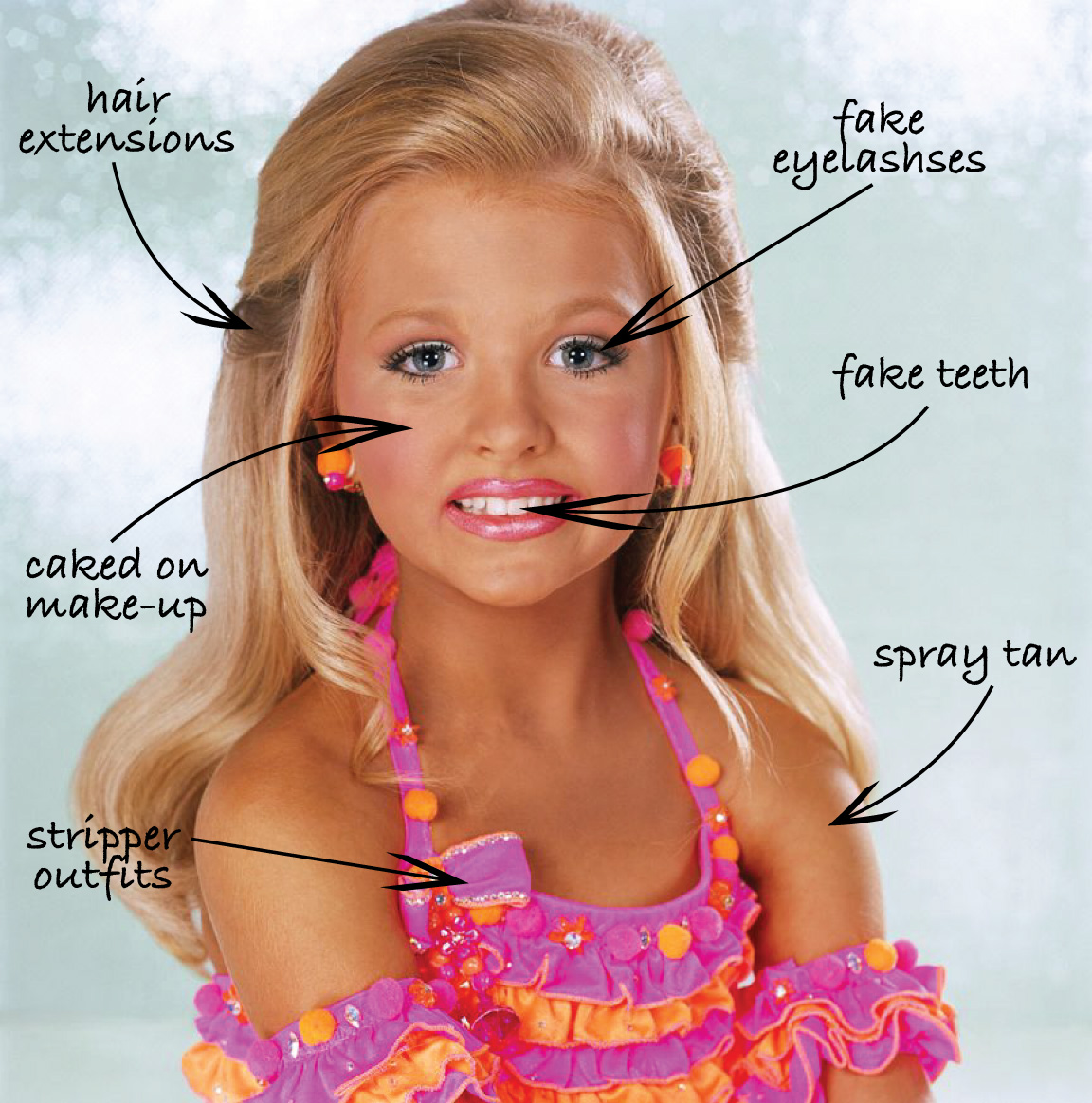
           In parallel, some young girls in America are facing similar circumstances to these child brides: the stars from 'Toddlers and Tiaras'.  These young girls are heavily encouraged and usually forced by their parents to participate in pageant shows that require hours of pampering and are purely focused on outer beauty.  These toddlers get spray tans, fake nails, fake eyelashes, fake teeth, colored contacts, and heaps of makeup are applied to their tiny faces on top of all that they are dressed in inappropriate clothing.  

As a viewer states "These poor girls are being exploited before millions of national viewers at every level. At the most tender of age, they are being told to show more skin, sashay seductively and diet".  Clearly this show is faced with controversy, but its still a very popular TV show and has been on air for several years.  Not only does this send the wrong message for girls, but similarly to the girls being forced in to marriage these young American girls are forced to shed their innocence too early.  They are unwillingly forced by they’re parents to engage in an activity.  In both cases it helps the parents economically, in child weddings the parents no longer have to support their daughter and in pageant shows the winner is rewarded with large amounts of cash.  Both child marriages and pageant shows force young girls to grow up too fast.  For in child marriages girls are forced to take care of a family and pageant girls are forced to look a certain way and care about how they look, which takes away the innocence of childhood.  I believe pageants spoil the charm and innocence that childhood so delicately holds.